Yamaha MO8 88-Key Music Production Synthesizer
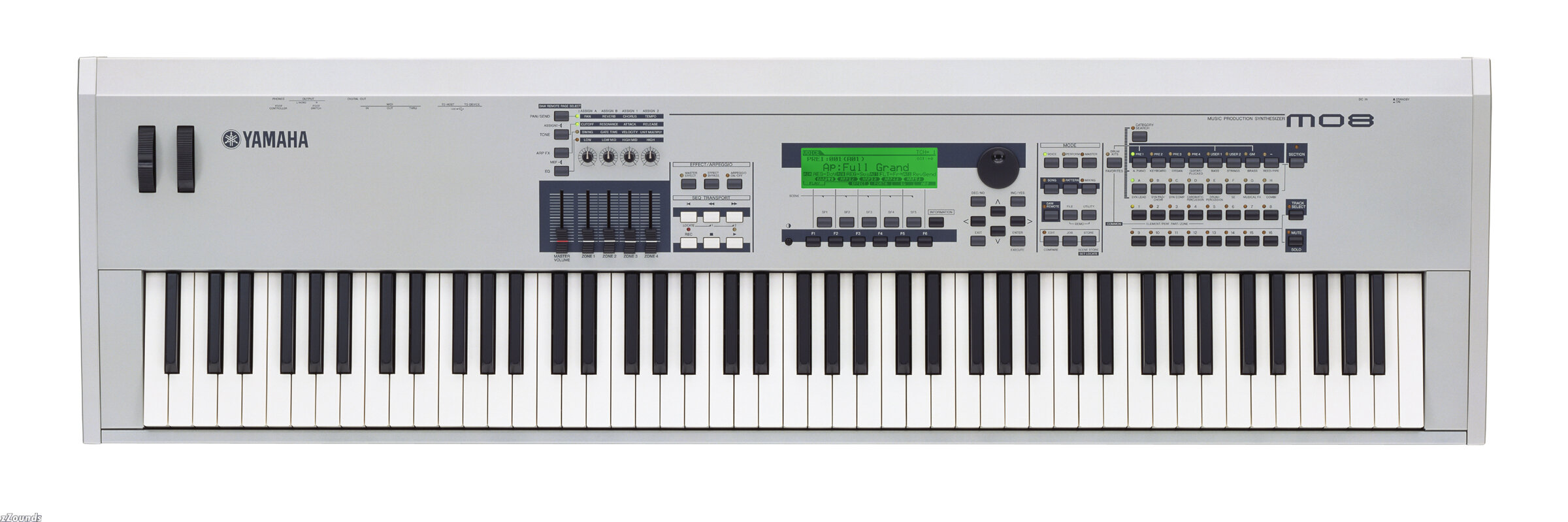 There's no denying that the Yamaha MOTIF is one of the finest-sounding workstation keyboards around. Also hard to deny: its price. Hey, you want the best in the game, there's always a cost. But what if there were some way to get all those amazing sounds at a fraction of the MOTIF's price? What if you could still get the awesome sequencing features and DAW integration the MOTIF ES has to offer, too? There just so happens to be a keyboard workstation that fits that exact description: the Yamaha MO8.
Built off the powerful AWM2 sound engine that's at the core of the MOTIF ES, the Yamaha MO8 88-Key Music Production Synthesizer puts that MOTIF sound well within reach of most musicians, without sacrificing functional design or sonic power.
MOTIF ES Sound Engine
Sound quality is the deal-maker or -breaker on any workstation keyboard, and the MO8 delivers. It boasts the same powerful synthesis engine as the industry standard MOTIF ES, so you can show up to any gig, session, or production date with your MO' in hand knowing you're packing some of the most explosive sounds in the biz. All the celebrated Yamaha sample-based instruments are there, including their much-lauded acoustic grand piano patches. Percussion sounds spanning from life-like studio kits to cutting edge hip-hop beats are at all your disposal. You even get the breathtaking MegaVoice instruments; when coupled with the Yamaha MO8's sophisticated arpeggiator, the MegaVoices recreate subtle playing nuances like guitar hammer-ons and pull-offs, or clarinet grace notes and over-breath noise. Also on board are the impressive analog-synth modeling capabilities of the MOTIF ES. A four-oscillator sound-generator architecture, multi-band filter, and dynamic envelope controls effortlessly recall the entire history of modern musical synthesis. Ever said to yourself "I know exactly what this track needs"? The MO8 has that sound, whatever it might be; it's like having every vintage synth you've ever heard, instantly at your fingertips. The MO's array of solid sliders and knobs provide assignable, real-time control over every instrument parameter, as well as over the comprehensive DSP effects. Yamaha wouldn't have called it a Music Production Keyboard without including a wide array of studio-quality effects, so along with the hundreds of voices, they ported the MOTIF ES's EQs, choruses, reverbs, compressors, and radical lo-fi, digital scratching, slicing, and beat change FX to the MO8. More than providing you with every sound you can think of, the MO8 will inspire you with sounds you never thought possible.
A Studio And Stage Performer
Like the MOTIF series, the MO8 is an expressive instrument, sure to inspire great performances on stage and in the studio. The full 88-key keyboard sports Yamaha's Balanced Hammer Effect keys for satisfying resistance and tactile feel that's similar to an acoustic piano. Tour-ready sounds like tonewheel organs, electric pianos and a gamut of real-time effects like vintage phasers and touch-sensitive wah-wahs are meaty and responsive; the rest of the band is sure to love them as much as you will. While the MO8 may not boast the same lavish, full-color screen as its big brother, it still features the same intuitive navigational tools that make finding the right sounds quick and easy. Entire preset "scenes" comprising groove phrases, multi-voice patches and specific effects chains can be recalled from a single "Master Mode" setting; it makes recalling complicated voice combinations for an entire song simple in a live setting, and creating song-writing presets in the studio a snap. When you do take your Yamaha MO8 on the road, you'll be happy to find it's a lightweight and rugged traveler.
Easy Studio Integration
Some folks think that the advent of easy computer recording marked the end of the keyboard workstation. . . not so with the MO'. While the MO8 does stellar work as a stand-alone sequencer, Yamaha also designed it to become an integral part of your project or home studio. Using Mackie's near-universal control protocol, the MO8 can be effortlessly set up to control all basic DAW functions like transport controls, track volume, panning, and can even control virtual instrument parameters. On the flip side, the Yamaha MO8 can be inserted like a plugin soft-synth into any VST-hosting software, making incorporating the MO's hundreds of instruments, grooves and effects into you multi-track projects utterly seamless. If you've got other outboard sound modules in your studio, the MO8 can control those too, thanks to full MIDI I/O and multi-zone mapping capabilities. The "Total Recall" feature works with your DAW to save external hardware setting--whether on your MO8 or other hardware synths--in the same master file as the rest of the project. Complete hardware/software integration has never been easier.
Offering producers, performers, and home recordists incredibly cost-effective access to the MOTIF world, the Yamaha MO8 is the perfect complement to any computer production studio, as well as a killer live instrument. Now everyone can tap into the Yamaha music production muse!
Description :
From Acoustic to Analog - the MO has it all!
The heart of the MO series is the same massive 175 MB wave ROM and synth engine found in the flagship MOTIF ES. Complete with expressive, multi-velocity acoustic pianos and EPs, MegaVoice guitars and basses that capture all the subtle nuance of the real thing and a vast selection of string, brass and other acoustic sounds, the MO is ready for any type of music production. A huge selection of different drum kits instantly inspires new beats and grooves. Whether you need realistic rhythm tracks or orchestral backgrounds, the MO has all the sounds you need in one place. But don't be fooled, the MO is not just for acoustic emulations. The 4-oscillator Voices feature multi band filters and snappy envelopes so there's also a complete selection of analog and digital synth sounds from funky basses, silky leads to atmospheric pads. Realtime controls and an advanced modulation matrix, let you easily shape those sounds to fit your production needs.
The MO also includes advanced effects processing including Reverbs, Chorus & Delays, 16 individual Part EQs and powerful dual Insertion effects that can be applied to up to three parts in a Mix or Performance. The Insertion effects feature some of the most creative and unique DSP processing on the planet including lo-fi, digital scratching, slicing, and beat change.
If you're looking for the most expressive acoustics sounds from pianos to drums, the widest selection of the freshest synth basses, leads and pads and the most powerful DSP processing available, you'll find that nothing in its price range has any MO.
The MO Goes with the Flow
As a musician these days you find yourself in lots of different situationslive gigs, song writing collaborations, studio sessions and computer music environments loaded with DAWs and SoftSynths. The MO series was designed to adapt to each of these different applications with their own special demands and provide just the right feature set for each situation. The responsive Voices and real time controls allow you to express subtle emotions in live performance. The Performances are not only live ensembles with splits and layers, but many use the MO's Phrase Factory Arpeggios and are complete grooves to instantly inspire new song ideas. But most important of all, the MO series was designed to be not just a keyboard, but the center of a computer based music production studio. It offers a DAW remote control mode that gives you full hands on remote control of DAW and SoftSynths. The Studio Connections compatibility let you treat the MO as a VST SoftSynth inside Cubase SX 3.1 and Nuendo 3.1. The special Utility Quick Setups let you easily change from one style of working to the next. So no matter how you like to work, the MO series adapts to fit your workflow and lets you be more musically productive.
The Perfect Song Writing Partner
Some people might wonder why you need a built-in sequencer in a workstation keyboard when there are so many powerful computer software programs like Steinberg's Cubase products available today. But the MO's Song and Pattern sequencer was actually designed to be a creative scratch pad to let you quickly and easily get your song writing ideas down. Much of today's music is looped based and having a Pattern sequencer let's you work in sections that can be easily chained together to try different song arrangements. So when working on new song ideas, it's often faster and easier to use the MO's on board sequencer to get your ideas down quickly while inspiration is still fresh.
The new Utility Quick Setups also let you transfer from the internal sequencer to your computer with a single button press. Because the MO is a complete self contained system - including a keyboard, tone generator and sequencer. It's great when you want to be on the move and collaborate with friends.
Jam On!
The MO6 and MO8 are light in weight and extremely portable so they are great for live performance situations. The MO8 features a Balanced Hammer action keyboard like that found on the MOTIF ES8.
Both the MO6 and MO8 feature hand on knobs and sliders for real time controls and a full compliment of pedal control inputs as well. The MO series also features full multi zone MIDI capabilities for controlling external tone generators, SoftSynths and other keyboards in your rig.
With it's high quality built-in DSP effects, the MO sounds great going directly into your band's PA mixer. Light in weight and heavy on features, the MO series is a working musician's dream.
Project Studio - Controlling your DAW with your MO
Today's project studios are centered around the computer and the MO series total integration with computer production systems is what really separates it from the competition. It features both USB "TO HOST" and USB "TO DEVICE" ports. The "TO HOST" port lets you connect multi-port MIDI to your computer with a single USB cable. The "TO DEVICE" port lets you connect USB storage devices like hard disk drives and thumb drives (USB flash memory) directly the MO for saving voices, performances and songs and backing up files to your computer. Digital Audio connectivity is standard with a stereo coaxial digital output for noise free digital recording of your MO to your computer sound card, a DAT or CDR.
The MO series also features a DAW Remote Control Mode that allows full hands on control of popular DAW software including Sonar, Logic, Digital Performer and the full range of Steinberg Cubase and Nuendo products. You can control Volume, Pan, Solo, Mute, Track Arming, Track Select and many other track specific functions. The Transport controls on the MO series can be setup to stop, start and return to zero your DAW projects. You can even edit and control VST/AU plug-ins and see their parameters displayed in the LCD display of the MO. Total control over your DAW and SoftSynths from your hardware synth has never been easier.
Home Studio - Controlling your MO with your DAW software
Perhaps the most exciting part of the MO series is the powerful cross platform software that can be downloaded from www.yamahasynth.com. Full Voice and Multi Part Editors are available that let you edit and store MO setups via your computer. Even more amazing, using the latest versions of Cubase SX or Nuendo, you get all the benefits of full Studio Connections compatibility. No more trying to remember what Voices you used in that project you were working on three months ago. Just launch the project and Studio Connections "Recall" will reconfigure your MO to exactly the settings that were last used in the project.
With Studio Connections "Audio Integration", you can even turn your MO into a Virtual Synth complete with phase accurate latency compensation and add VST effects directly to your MO inside your VST mixer. Imagine the convenience of Freezing a track on a hardware synths and then being able to continue working on your project even when the hardware is not connected.
Total Integration = Total Control
Total control over your DAW and SoftSynths with the MO's DAW Remote Control Mode has never been easier. Total control of your hardware synth from your DAW software with the MO's Studio Connection compatible software has never been easier. Now you can utilize all the power of the total computer integration in the MO series to make more music.
What is Total Recall
Total Recall is the first phase of the Studio Connections project. The Voice and Multi Part Editors for the MO Series are Total Recall compatible so they work inside the Studio Manager system available in the latest versions of Cubase and Nuendo. Studio Manager can be opened directly from inside your Steinberg software and contains editors for a variety of Yamaha synthesizers, mixer and effects. Saving a project in Cubase and Nuendo saves all your Studio Manager editor settings right along with your project file. Just open your project file again and Studio Manager will restore your MO (and the rest of your MIDI Studio) to the exact same settings as when you last worked on that project.
Totally simple - Total Recall.
What is Audio Integration
Audio Integration is the next phase of the Studio Connections project. It allows you to setup the MO Series as a VST Instruments via the "External Instrument" function found in Cubase SX 3.1/Nuendo 3.1. Now you can use the MO Series just like a plug-in, routing it to the DAWs Audio mixer, applying VST effects and even using unique VST functions such as "mix down" and "freeze". Finally youve got a seamless environment where both hardware synthesizers and software synthesizers can be completely integrated together.
Totally Cool - Total Integration.
The new MO series brings the sonic palette and music production power of the award winning MOTIF ES to a new generation of players and producers. Equally at home on stage, in the studio or in a computer based home recording system, the MO series is not just a keyboard, but the heart of your music production system. Killer sounds, a complete Song and Pattern based sequencer, powerful on-board effects processing and total computer integration come together to make these the most affordable music production synthesizers in the Yamaha line up.
Technical Info
MO8: 88 keys, Balanced Hammer Effect keyboard (initial touch)
Tone generator: AWM2
Polyphony: 64 notes
Multi-timbral capacity: 16 parts (internal)
Wave: 175MB (when converted to 16-bit linear format), 1,859 waveforms
Voice:
-- Preset: 512 normal voices + 64 drum kits
-- GM: 128 normal voices + 1 drum kit
-- User: 128 x 2 (bank 1: original, bank 2: picked up from preset), normal voice + 32 drum kits
-- Performance user: 256 (up to 4 parts)
Filter & effect system: 18 types (filter), reverb x 20 types, chorus x 49 types, insertion (a, b) x 116 types x 3 blocks, master effect x 8 types, master equalizer (5 bands), part EQ (3 bands, stereo)
Note capacity: approx. 226,000 notes
Note resolution: 480 ppq (parts per quarter note)
Maximum polyphony: 124 notes
Tempo: 1 - 300
Recording type: real time replace, real time overdub (with the exception of the pattern chain), real time punch (song only), step (with the exception of the pattern chain)
Tracks:
-- Pattern mode: 16 phrase tracks
-- Pattern chain mode: pattern track, tempo track, scene track
-- Song Mode: 16 sequence tracks (loop on/off can be set for each track), tempo track, scene track
Patterns: 64 patterns (x 16 sections), measures: 256 maximum
Phrases:
-- Preset phrases: 687 phrases
-- User phrases: 256 per pattern
Songs: 64 songs
Mixing voices: 16 per pattern (256 maximum)
Mixing templates: 32
Arpeggio:
-- Preset x 1787 types, User x 256 types
-- MIDI Sync, MIDI transmit/receive channel, velocity limit, and note limit can be set.
Scene memory: 5 per song
Sequence format:
-- MO6/MO8 Original format (compatible with MOTIF ES)
-- SMF format 0, 1 (Format 1 load only)
Master:
-- User: 128
*4 Zones (master keyboard settings), assignable knob/slider settings, program change Table
Sequence software compatible with the Remote Control function:
-- For Windows: Cubase SX 3, SQ01 V2, SONAR 4, MO6/8/MOTIF ES/MOTIF-RACK ES/MOTIF-RACK/S90 ES Multi Part Editor
-- For Macintosh: Cubase SX 3, Logic Pro 7, Digital Performer 4.52, MO6/8/MOTIF ES/MOTIF-RACK ES/MOTIF-RACK/S90 ES Multi Part Editor
*Functions to be controlled by the MO6/MO8 differ depending on the software you use.
Controllers: pitch bend wheel, modulation wheel, assignable control sliders (4), assignable knobs (4), data dial
Display: 240 x 64 dot graphic backlit LCD
Power consumption: 13.5 W
Dimensions (WxDxH), Weight: 54.28 x 15.44 x 6.68 in., 21kg
Read more...